
Who Is Really Managing Your Money?


And how much do they know about the life your money is meant to serve?
“I have someone who handles my investments.”
For many people who have accumulated substantial wealth, those words bring a certain relief. The money is invested. Statements arrive. There is a person to call. Markets rise and fall and someone, presumably, is paying attention.
But there are two questions we rarely ask together: Who is actually making the decisions about my money? And perhaps more importantly, what do they truly know about my life?
Not simply my age, account balance, retirement date and tolerance for market risk, but the life that money is meant to serve.
The person you know may—or may not—be the person making the decisions
Modern wealth management comes in many forms. You may work with an independent adviser who personally constructs and manages your portfolio; an adviser supported by a dedicated investment team; or a large brokerage, private bank or national wealth-management firm where some or most portfolio decisions are made elsewhere. Your investments may be individually constructed, substantially model-based, or some combination of the two.
Any of these arrangements can work very well. The more useful question is whether you understand the arrangement you have—and whether it is appropriate to the life and wealth you are aiming to steward.
Professional titles can describe very different roles. Terms such as financial advisor, financial consultant, financial planner, investment consultant and wealth manager are used across the industry and do not, by themselves, tell you precisely what role the person performs. Nor is this simply a question of pedigree, degrees or the size of the institution behind the business card.
• What is this person actually responsible for?
• Does the person I speak with decide what I own?
• If not, who does—and do I have access to that person?
• What does the person making those decisions truly know about me?
Do you know how your portfolio is actually built?

Model portfolios have become a major part of modern investment management. In a Natixis Investment Managers study, 93% of surveyed U.S. financial advisers said they used some form of model portfolio—their own, their firm’s, or one created by a third party. Among 750 surveyed investors who worked with an adviser, about half said they were invested in models; another 22% did not know whether they were or not.
That last number may be more interesting than the first. There is nothing inherently inferior about a model portfolio. Models can provide a consistent, diversified and efficient framework for investment management. Natixis also found that investors using models reported greater confidence and trust in their advisers than those who were not.
The point is not that models are bad. The point is that you should know what you have.
• Is your portfolio individually constructed, substantially model-based, or a blend of the two?
• If it began with a model, what makes it specifically yours and true to your life goals, needs and wishes?
• What information about you would cause the portfolio to depart from that structure?
• What would cause it to change—and who makes that decision?
What exactly is being personalized—the portfolio category, or the life it is meant to serve?
Your life is investment information
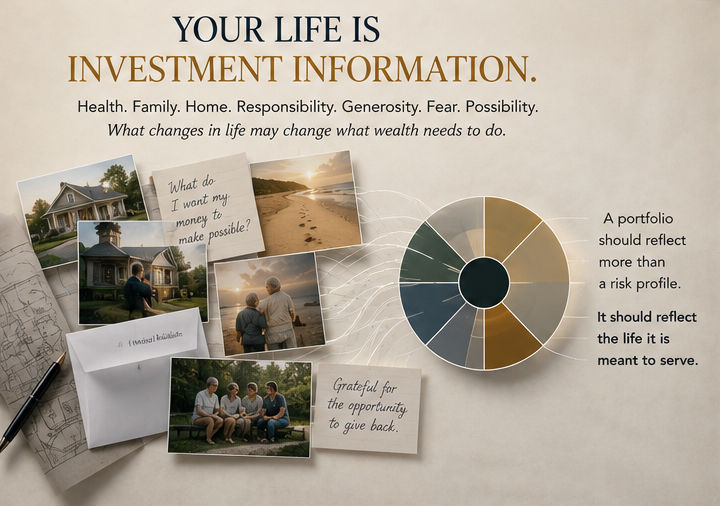
This may be the part of wealth management we talk about least.
Imagine two women. Both are 68. Both have approximately $3 million invested. Both are retired. Both describe themselves as moderately conservative investors. On paper, they may look remarkably similar.
But one lost her husband last year and has become increasingly anxious about managing the house alone. The other has an adult son who is struggling and asking for part of his inheritance now. One wants to spend substantially on her house because she intends to remain there as she ages. Another has begun to wonder whether she has saved too diligently and wants to enjoy more of what she accumulated while she is healthy. One is frightened by a new diagnosis. Another has become deeply committed to a cause she wants to support. One wants to maximize what remains for her children. Another is beginning to think: I want some of this money to do something meaningful while I am still here to see it.
Are those investment considerations? They certainly may be. Not because every event in someone’s life should trigger a trade. Quite the opposite. The value lies in having someone capable of asking: Does this change anything about how this client should be positioned?
A health diagnosis may change expected spending or liquidity needs. A family problem may alter gifting or estate intentions. A decision to remain in a house may affect reserves and future cash needs. Widowhood may change both financial circumstances and a person’s relationship with risk. A new sense of purpose may change what someone wants to spend, give away or leave behind. Even anxiety can matter—not because a portfolio should follow every emotion, but because a portfolio that is theoretically appropriate and psychologically unbearable may not be appropriate at all.
Life changes first. Financial consequences often follow.
Yet many investors have never been taught to see these parts of their own lives as information relevant to the stewardship of their wealth. Would you think to call your investment adviser because you were remodeling your house, helping an adult child, facing a frightening diagnosis, considering a meaningful gift, or questioning what you want the next decade of your life to look like?
Many people would not. We have learned to divide these matters into categories: that is my life; this is my money. The adviser handles the money. I handle the life. But money does not actually live in a separate compartment. It lives inside the life.
This suggests a look into your own participation
An unusually attentive adviser still cannot know what the client never shares. And the client may not share something because no one has ever given them a reason to believe it matters. That creates a responsibility on both sides of the relationship—not a responsibility to become an investment expert or follow the market every day, but something more personal: to participate in your wealth as a significant part of participating in your life as its needs and direction change.
That means continuing to notice what is changing. What matters now that mattered less five years ago? Who depends on you? Whom do you want to help—and how much help is actually helpful? What are you still trying to protect? What are you unnecessarily afraid to spend? What are you afraid to not do while you still can?
It also means asking what you want to create, repair, protect, experience or give away. Where could generosity make a meaningful difference? What people, places, causes or possibilities matter enough that you want some portion of what you have accumulated to serve them? And how often will you revisit those choices as life changes?
Have I become so busy living my life that I have stopped asking what I want my wealth to make possible now—or next?
This is not an argument for spending more, nor for leaving less. It is an argument for conscious stewardship. Accumulated wealth represents choices—about security, family, independence, generosity, responsibility, creativity, legacy and experience. Some of those choices may still be undiscovered or underserved.
In this most fundamental stewardship relationship, clients may never have been taught to see daily life shifts and challenges as essential investment information. If the purpose of wealth is to serve what matters, then participating in wealth means continuing to discover what matters at each stage of living—and making sure the person helping manage the money knows.
One life. Many accounts. Who sees the whole picture?

Many affluent investors do not actually have one financial relationship. A 2025 Janus Henderson survey of investors age 50 and older with at least $250,000 in investable assets found that 89% had investment accounts at multiple financial institutions. A third used two providers, 29% used three, and 27% used four or more.
That is not necessarily a problem. Investors may have perfectly sensible reasons for maintaining several relationships.
But it creates an important question: Who—if anyone—sees the whole picture?
Who knows about the retirement assets here, the inherited holdings there, the concentrated stock position, the cash, the house, the insurance, the family commitment and the thing you are considering doing next year?
Advisor360° asked 2,000 mass-affluent and high-net-worth individuals about something closely related. Eighty-six percent said their adviser should have a comprehensive view of their total wealth profile. Only 40% said their adviser actually did.
The gap is striking. Yet older investors were among those most reluctant to share their entire financial picture. So, the question also turns back toward the client: Do I want someone to understand and serve the whole picture of my life, wishes, needs and changing circumstances? If I don’t, what am I sacrificing of my life values wants and needs? …And if I do, have I actually allowed anyone to see it?
Affluent investors are placing greater value on holistic advice
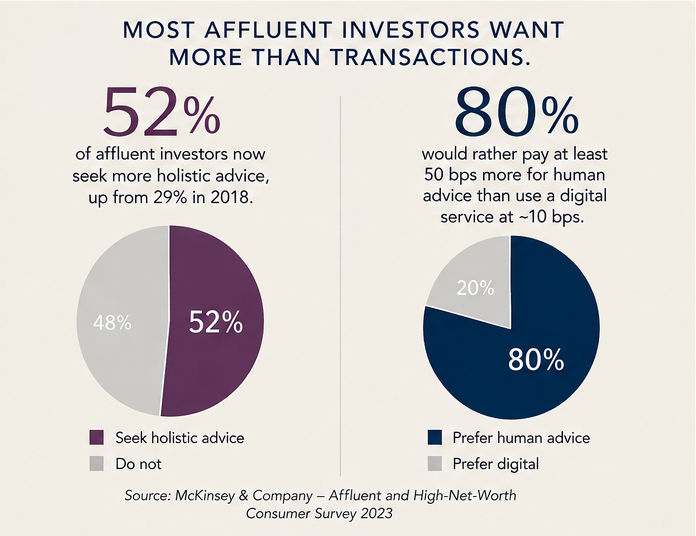
The desire for a broader relationship with one’s investment advisors is not merely anecdotal. McKinsey’s survey of approximately 7,000 affluent and high-net-worth U.S. investors found that the share seeking more holistic advice rose from 29% in 2018 to 52% in 2023. The same research found that almost 80% of affluent households would rather pay at least a 50-basis-point premium for human advice than using a customized digital service priced at approximately 10 basis points.
Technology matters. Investment systems matter. Research and scale matter. But affluent investors appear to place considerable value on human judgment that requires deeper synthesis than data alone can achieve.
Perhaps the more revealing question from this research is what kind of human relationship they are actually receiving.
When your life changes, does the person making the decisions know?

Markets change constantly, and modern investment management is well equipped to track those changes. Interest rates move. Companies report earnings. Asset classes rise and fall. Portfolio allocations can shift as investments change in value. Investment systems can track these changes and help advisers determine when attention or rebalancing may be warranted.
But something else changes constantly too: you—your health, family, relationships, home, work, obligations, fears, ambitions, sense of responsibility, definition of enough, what you want to protect, what you want to give, and what you want the next ten years to encompass.
Markets produce data that systems are designed to track; changes in a person's life require a different kind of attention.
Who is attending to those changes? And when something important changes, does the person who knows also have meaningful influence over how your wealth is invested?
There is a potentially large difference between monitoring a portfolio and remaining close enough to the person to understand what the portfolio is meant to accomplish at each stage of living.
Suppose something important happens tomorrow. You tell your adviser. Then what? Perhaps your adviser is also the person making your portfolio decisions. Perhaps your adviser works directly with a portfolio manager who knows you well. Perhaps an integrated team communicates everything necessary. All of these arrangements can work.
But if you do not know, ask:
Who ultimately decides what I own? Does that person know me? When something changes in my life, how does that information reach them? Who decides whether the change matters financially? When something important changes in my life, does that information actually reach the person making decisions about my money?
We looked for a reliable industry statistic showing what percentage of affluent investors have sustained direct access to the same individual who actually makes or materially controls their portfolio decisions. We could not find a credible number. Perhaps that makes the question more worth asking—not less.
Wealth is Stored Possibility: Continuity may matter more than we realize
There is another question hidden inside all of this: Will the person who knows you today still know you five years from now?
McKinsey found that 32% of affluent and high-net-worth investors switch firms when an existing adviser leaves through retirement or another departure. That tells us something important. An institution may hold the account, but over time a person may hold the relationship.
There is knowledge accumulated inside a long relationship that is difficult to reproduce in a database: how someone reacts under pressure; what she says she wants and what she repeatedly demonstrates matters more; the family history behind a financial decision; the old fear that surfaces during every market decline; the child they worry about; the dream he keeps postponing; the thing he once insisted he would never do and has now begun to consider.
That kind of knowledge accumulates slowly. When continuity disappears, the context behind investment decisions—and some of the structuring built around that context—can disappear too.
A question we may not ask often enough: What is this wealth for?
There is evidence that even large and consequential life considerations do not always make it into advisory conversations. J.D. Power’s 2026 Investor Satisfaction Study found that among clients age 40 and older with a dedicated financial adviser, only 39% said their adviser had discussed elements needed for a future wealth transfer.
Perhaps that is partly an adviser question. But perhaps it is also a client question. Have I talked about what I want to happen? Have I thought deeply enough about it myself? Do I know what I want to give my children—and what I do not want to give them? Is legacy only what remains when I die? Could some of it happen while I am alive? Does my wealth have a responsibility beyond maintaining itself?
Those are not questions a portfolio-management algorithm can answer. And perhaps they should not be answered by an adviser either. They belong to the person whose life produced the wealth. The adviser’s role may be something different: to know enough, listen closely enough, and understand the financial consequences well enough to help ask the appropriate questions and to connect the answers to the money.
A private check-in with your own wealth
Who actually decides what I own? Is it the person I speak with, a portfolio manager, an investment committee, a model—or some combination?
Does the person making those decisions actually know me? Not merely my account information. My changing life.
If my wealth is spread among several institutions, who sees the whole picture?
When something significant happens in my life, whom would I call? And would I even recognize that it was relevant to tell my adviser?
How does that information reach the person making investment decisions?
Will the person who knows me today still be there five years from now?
What has changed in my life that my financial arrangements may not yet know about?
And finally:
Am I participating actively enough in my wealth to help it serve what matters most to me?
The kind of relationship we may have forgotten exists
There was once a kind of family doctor who knew considerably more about a patient than what appeared in the medical chart. He knew if your husband had died. He knew which child kept you awake at night. He knew you were caring for your mother. He knew you tended to minimize pain. He may have known your parents before he knew you. Sometimes he came to the house.
Modern medicine gained extraordinary technology, specialization, scale and expertise as that model faded. We gained something enormous. But something was also lost: continuity, context, being known.
Perhaps wealth management is confronting a similar question. Large organizations can provide extraordinary investment resources. Technology can monitor portfolios continuously. Models can impose valuable discipline. Specialists can bring expertise no single person could possess alone. None of those things is the enemy of a personal relationship. But none automatically creates one either.
Who truly knows me?
Not just my account; not merely my risk score or the information entered into a system, but me. Who knows what I am facing? What I am afraid of? What I am beginning to hope for? Who knows that something I said I wanted three years ago is no longer quite true? Who recognizes that what looks like a family matter today may become a financial matter tomorrow?
And who is close enough—and involved enough in the actual management of my wealth—to recognize when something may need to change? That kind of relationship still exists. But perhaps many investors do not know that it is something they can look for.
The question is not only whether your money is being managed, it is whether your wealth remains connected to the life from which it came, where that life stands now, and where it is moving.
Does your portfolio still serve your security; the people you love; responsibilities you consciously accept; responsibilities you may finally be able to release; places and causes you care about; experiences you still want to have; work you want to create; generosity you want to practice; and possibilities you have not yet allowed yourself to consider?
A portfolio can be managed efficiently for years without necessarily addressing any of those larger life questions. Which is why perhaps the most consequential question is not simply: Is my money being managed? But rather, am I participating deeply enough in my own life to know what I want my wealth to make possible—and does the person managing it know me well enough to help connect the two?
Because there may be a far greater loss than earning a fraction less than some benchmark in a particular year. It is possible to accumulate enough money to create extraordinary choices and never fully enter into them; to preserve wealth without quite deciding what it is meant to preserve; to protect against every imaginable future while possibilities in the present quietly pass by; to leave an inheritance without considering what generosity might accomplish while you are still here; to have enough—and never quite discover what that enough could make possible.
Wealth is not merely something to manage. It is stored possibility.

Good stewardship is therefore more than keeping wealth invested. It is the continuing work of connecting what you have accumulated with what matters enough at each phase in your life to do something about.
That requires ongoing participation from you. And perhaps, if you are fortunate, it also means having someone beside you who has known you long enough, listens closely enough, and remains involved enough to recognize when your life has changed—and understands that your money may need to change with it.
Research & Further Reading
Advisor360° — 2023 Connected Wealth Report: Client Edition
Natixis Investment Managers — 2023 Model Portfolios Report
McKinsey & Company — The Looming Advisor Shortage in U.S. Wealth Management
Janus Henderson Investors — Why Investors Aren’t Consolidating—and What Advisors Can Do About It
J.D. Power — 2026 U.S. Investor Satisfaction Study
FINRA — Professional Designations and Credentials
RELATED CLEMENTS INVESTMENT MANAGEMENT PERSPECTIVE
What Is Your True Currency? A conversation with Matt Clements about money, fear, risk, and what a portfolio is meant to serve.


